
Politics
EC Chair Petition Ruling Raises Uncomfortable Consistency Questions

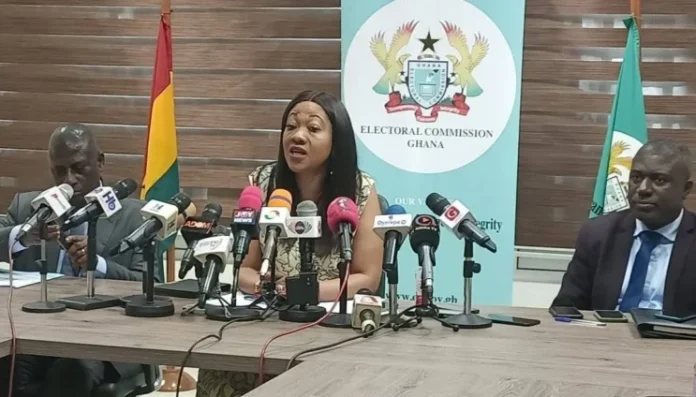
When Chief Justice Paul Baffoe-Bonnie dismissed ten petitions against the leadership of the Electoral Commission (EC) and the Office of the Special Prosecutor (OSP) last month, the constitutional process worked exactly as designed. The Chief Justice reviewed the petitions, found no prima facie case, and the matter closed. But the manner in which he applied the threshold for a prima facie determination has opened a debate that refuses to close quietly, and former Tamale Central Member of Parliament (MP) Inusah Fuseini gave that debate its clearest articulation yet on Sunday.
President Mahama received seven petitions from individuals and groups seeking the removal of EC Chairperson Jean Adukwei Mensa and her two deputies, Dr Bossman Eric Asare and Samuel Tettey, along with three separate petitions against Special Prosecutor Kissi Agyebeng. In line with Article 146 of the 1992 Constitution and Section 15 of the Office of the Special Prosecutor Act, 2017 (Act 959), the President referred all ten petitions to the Chief Justice on November 25, 2025. Among the grounds cited were allegations of cronyism, abuse of office, and gross incompetence. One petition, filed by EC staff member Joseph Blankson Adumadzie, contained twelve counts of alleged stated misbehaviour, including claims that the officials’ conduct had eroded public confidence in the Commission and threatened Ghana’s electoral credibility. By letter dated January 26, 2026, Chief Justice Baffoe-Bonnie informed President Mahama that no prima facie case had been established to warrant further investigations.
Fuseini, speaking on JoyNews’ Newsfile programme, said the Chief Justice’s ruling raises two distinct but related concerns. The first is factual. He argued that certain communities were left without parliamentary representation following what he described as the EC’s failure to create a constituency after an election had already been conducted, a constitutional harm that he said is difficult to characterise as anything other than serious regardless of whether it was intentional. “The people exist. They are by law to be represented in Parliament. An election was conducted. These people were not represented in Parliament,” he said. In his view, acknowledging that a constitutional question exists, as the Chief Justice apparently did in his reasoning, while simultaneously finding it insufficient for a prima facie determination, sets a troubling precedent.
The second concern is jurisprudential. Fuseini noted that previous applications of Article 146, including cases involving alleged breaches of statutory procurement obligations, had been deemed sufficient to meet the threshold for establishing a prima facie case. If constitutional breaches can cross that threshold in some contexts but not in others, he argued, the standard becomes uncertain. “Consistency is a virtue in jurisprudence,” he said. He stopped short of accusing the Chief Justice of partiality, framing the ruling instead as reflecting an institutionalist philosophy prioritising the stability of constitutional offices over the detailed investigation of allegations that stopped short of proving intentional misconduct.
Fuseini was not alone in raising the consistency point. Lawyer and activist Oliver Barker-Vormawor made the comparison explicit on social media, drawing a direct line between the standard applied in the EC petition dismissal and the standard applied when Chief Justice Baffoe-Bonnie, then serving as Acting Chief Justice, made a prima facie determination that enabled the removal process against his predecessor, Justice Gertrude Araba Esaaba Sackey Torkornoo. Barker-Vormawor argued that if the threshold applied in dismissing the EC petitions had been applied in Justice Torkornoo’s case, she would still be Chief Justice today. He said fairness demanded that she be reinstated if the same principles now applied consistently.
The constitutional framework provides no further avenue once the Chief Justice finds no prima facie case. Without that threshold being met, no investigative committee can be constituted and no removal process can lawfully proceed. EC Chairperson Jean Mensa, her deputies, and Special Prosecutor Kissi Agyebeng therefore remain in their positions, the matter formally settled at the constitutional gateway. Whether the debate over how that gateway was applied will have any lasting institutional consequence is a question that will be answered slowly, in future cases where Article 146 is again invoked and lawyers on both sides reach for precedent.
Source: www.newsghana.com.gh


TV3’s Godwin Asediba wins the 2025 BBC Komla Dumor Award
Media General Journalist and News Anchor Godwin Asediba has been adjudged winner of the 2025 BBC News Komla Dumor Award....


Government imposes GHC10,000 daily fine on DSTV for failure to submit pricing data
The Ministry of Communication, Digital Technology, and Innovations has impose a statutory fine of GHC10,000 per day on MultiChoice Ghana...


President Mahama to walk the runway at Ghana Fashion Week in July
In a bold and exciting announcement, President John Dramani Mahama revealed that he will make a special appearance on the...


Chez Amis gifts herself Rolls Royce Cullinan on birthday
Renowned Accra-based restaurateur Chez Amis has marked her birthday in grand style by gifting herself a brand-new Rolls Royce Cullinan,...


Akosua Ago Aboagye joins Sompa FM as Accra branch radio manager
Seasoned broadcaster Akosua Ago Aboagye has joined Sompa FM as the Radio Manager for its Accra branch. She made the...


Mahama unveils ‘Black Star Experience’ to boost tourism and culture
President John Dramani Mahama has announced the launch of ‘The Black Star Experience’ as part of his administration’s vision to...
-

 Showbiz4 days ago
Wanlov reveals how he used cutlasses to evade school authorities
-

 Politics7 days ago
Kpebu: SALL Disenfranchisement Alone Should Have Sealed EC Removal Case
-

 Politics5 days ago
Afenyo-Markin Takes NPP’s Political Philosophy to UCC Students
-

 Showbiz4 days ago
He treats us like children
-

 Showbiz4 days ago
Man pleads with policewomen to be kind after kids traumatized by past incident
-

 Showbiz6 days ago
I questioned God in my desperation for a child – Diana Hamilton opens up about faith
-
Politics4 days ago
Afenyo-Markin Tells UCC Students Mahama’s Flagship Plans Remain Unfulfilled
-

 Politics2 weeks ago
Omane Acheampong Criticizes Government’s Cocoa Sector Price Reduction