
News
Dubawa Ghana trains rural journalists from northern Ghana on fact-checking in Tamale

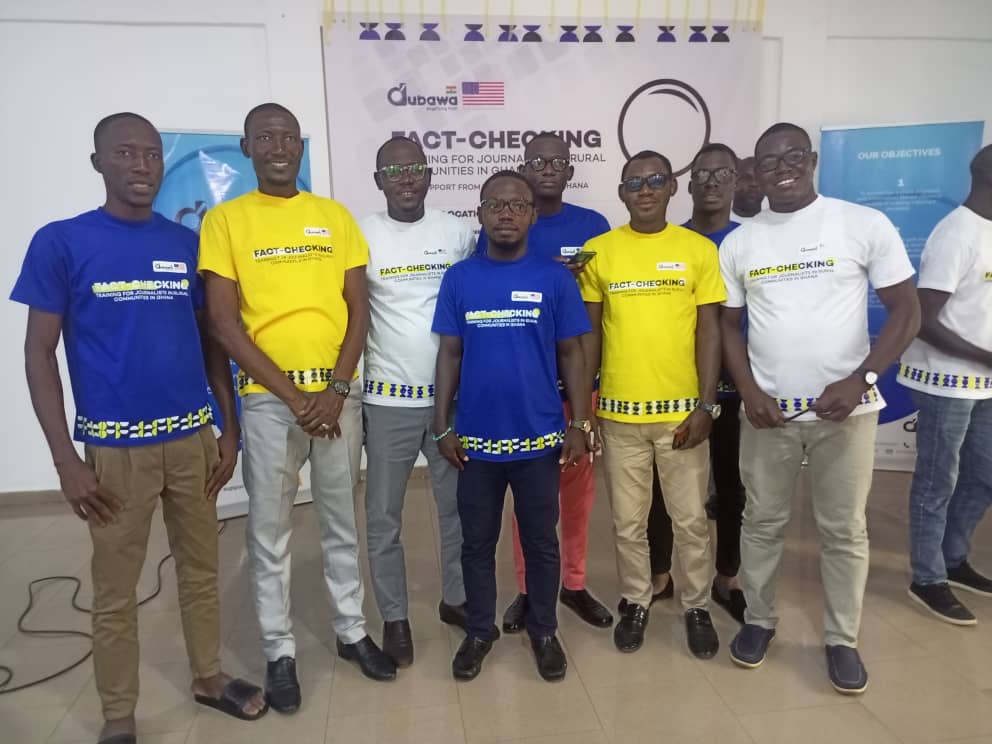
Dubawa Ghana trains rural journalists from northern Ghana on fact-checking in Tamale
fact-checking and verification organization, Dubawa has trained 20 media practitioners working in rural areas in northern Ghana on fact-checking to enhance factual and accurate reportage.
The training forms part of efforts made by Dubawa Ghana to train many journalists on fact-checking based news gathering in rural communities in the country. The project with funding from US Embassy in Ghana seeks to promote quality and facts based journalism in rural Ghana.
Madam Caroline Anipah, Dubawa Ghana’s team leader, underscoring the need for the training said there are a growing number of information disorders among journalists and media practitioners in the country. She further stated that based on concerns raised over the increasing levels fake misinformation, mal-information and disinformation there was the need to empower journalists especially those in rural areas with fact-checking journalism in order to properly educate and inform the public.
She noted that journalists in Ghana ought to be trained to understand fact-checking and stop misleading the public that could affect development of the country because the world is now inter-connected.
The Dubawa country boss encouraged the participating journalist to put to good use the knowledge they have acquired through the training.
Taking the participants through the topic; fake news and the law, Mr Zakaria Tanko Musah, a legal practitioner and lecturer at the Ghana Institute of Journalism enjoined the journalists to frequently use the Right to Information (RTI) Law to request information from institutions. He said journalists should also encourage the citizens to use the law to request information from the citizens.
“Using the RTI law to request information should not exceed fourteen days and if an institution or organization does not have the information requested for, the institution should direct the applicant to where he or she can get the information per the law” he added.
“After the fourteen days if journalist or any other person does not get the information he should insist by re-applying for it to make sure that the accurate information is gotten for publication” he explained. He therefore encouraged journalists to use the RTI Law judiciously to get accurate information in order to prevent practitioners from misleading the public.


TV3’s Godwin Asediba wins the 2025 BBC Komla Dumor Award
Media General Journalist and News Anchor Godwin Asediba has been adjudged winner of the 2025 BBC News Komla Dumor Award....


Government imposes GHC10,000 daily fine on DSTV for failure to submit pricing data
The Ministry of Communication, Digital Technology, and Innovations has impose a statutory fine of GHC10,000 per day on MultiChoice Ghana...


President Mahama to walk the runway at Ghana Fashion Week in July
In a bold and exciting announcement, President John Dramani Mahama revealed that he will make a special appearance on the...


Chez Amis gifts herself Rolls Royce Cullinan on birthday
Renowned Accra-based restaurateur Chez Amis has marked her birthday in grand style by gifting herself a brand-new Rolls Royce Cullinan,...


Akosua Ago Aboagye joins Sompa FM as Accra branch radio manager
Seasoned broadcaster Akosua Ago Aboagye has joined Sompa FM as the Radio Manager for its Accra branch. She made the...


Mahama unveils ‘Black Star Experience’ to boost tourism and culture
President John Dramani Mahama has announced the launch of ‘The Black Star Experience’ as part of his administration’s vision to...
-

 Showbiz5 days ago
Wanlov reveals how he used cutlasses to evade school authorities
-

 Politics5 days ago
Afenyo-Markin Takes NPP’s Political Philosophy to UCC Students
-

 Showbiz5 days ago
He treats us like children
-

 Showbiz7 days ago
I questioned God in my desperation for a child – Diana Hamilton opens up about faith
-

 Showbiz5 days ago
Man pleads with policewomen to be kind after kids traumatized by past incident
-
Politics5 days ago
Afenyo-Markin Tells UCC Students Mahama’s Flagship Plans Remain Unfulfilled
-

 Politics2 weeks ago
Omane Acheampong Criticizes Government’s Cocoa Sector Price Reduction
-

 Politics1 week ago
Kpebu: SALL Disenfranchisement Alone Should Have Sealed EC Removal Case