
Politics
GII, CDD-Ghana Move to Curb Campaign Spending and Vote Buying

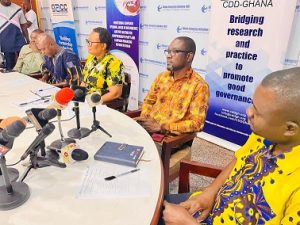
In a decisive move to safeguard the integrity of Ghana’s democratic process the Ghana Integrity Initiative (GII), Ghana Anti-Corruption Coalition (GACC), and the Ghana Centre for Democratic Development (CDD-Ghana) have launched a project dubbed: “Monitoring Campaign Spending, Abuse of Incumbency, and Vote Buying for Comprehensive Party and Campaign Financing Reform in Ghana.”
This initiative aimed at collecting campaign finance data for the 2024 presidential elections, addressing concerns about the role of money and the exploitation of state resources in politics.
The Executive Director of Ghana Integrity Initiative (GII) Mrs. Mary Awelana Addah addressing the media at the launch of the Project explained that the initiative, supported by USAID and the International Foundation for Electoral Systems (IFES), is designed to create a platform for stakeholders to push for reforms to Ghana’s campaign financing system.
Mrs. Addah highlighted the growing threats posed by the monetisation of Ghana’s democracy, particularly in the area of election financing.
“The influence of money on elections, the unchecked advantages of incumbency, and the harmful practice of vote buying not only undermine the integrity of our elections but also erode citizens’ trust in our democratic institutions,” she stated.
According to Mrs. Addah, a study by the Ghana Centre for Democratic Development (CDD-Ghana) and the Westminster Foundation revealed that candidates must raise an average of GH₵389,803 (approximately US$85,000) just to compete in a parliamentary election.
This financial burden alienates women, youth, and vulnerable groups from participating in the democratic process, exacerbating inequality in political representation.
Mrs. Addah further pointed out that despite the legal frameworks provided in the 1992 Constitution and the Political Parties Act, gaps remain in campaign finance regulations.
“Current laws do not provide for direct public funding of political parties, and there are no clear limits on donations,” she noted, adding that disclosure laws also lack stringent requirements for political parties to identify their donors, leading to a lack of financial transparency.
Another pressing issue raised was the abuse of state resources by incumbents. This includes the use of government vehicles, public events, state media, and security agencies for partisan purposes, which creates an uneven playing field during elections.
The GII Consortium’s new project will focus on monitoring these irregularities in the upcoming elections and provide evidence-based recommendations for reform.
“Our findings will inform advocacy efforts aimed at promoting comprehensive party and campaign financing reforms,” Mrs. Addah said, emphasizing the importance of elections being won based on ideas and policies, rather than financial backing or incumbency advantages.
The launch event underscored the essential role of the media in promoting transparency and accountability. Mrs. Addah expressed her optimism about working with media partners to raise public awareness and drive discussions on the need for electoral reforms.
As Ghana prepares for its 2024 elections, the GII Consortium’s project is expected to be a critical tool in ensuring a more equitable and transparent electoral process, with the ultimate goal of strengthening democratic governance in the country.
The Director of Programs of Ghana Centre for Democratic Development (CDD-Ghana Frederick Adu Gyamfi speaking on Campaign Financing and Abuse of State Resources during Elections also emphasized the urgent need for reforms in these areas.
Mr. Adu Gyamfi acknowledged the significant role money plays in modern politics but cautioned that it can have harmful effects on democratic institutions if not properly regulated.
“Money can develop and enhance our democracy, but it can also compromise democratic processes. Over the years, the use of money in politics has reached alarming levels, fostering corruption and mismanagement,” he said.
Citing a study by the Westminster Foundation for Democracy and CDD-Ghana, Mr. Adu Gyamfi revealed that the cost of running for political office in Ghana is exceptionally high.
Running for a presidential seat costs an estimated GHS 575 million, while running for a parliamentary seat can cost up to GHS 4 million.
This, he noted, creates a system where political campaigns are influenced by financial power rather than public interest.
Despite the existence of the Political Parties Act 2000 (Act 574), which requires political parties to disclose their financial accounts after elections, enforcement remains weak. “The lack of transparency, coupled with the absence of a cap on campaign expenditures, has allowed financial muscle to dominate the electoral process.
Candidates who spend exorbitant amounts on campaigns often prioritize recouping their investments rather than serving the public,” he added.
Mr. Adu Gyamfi also expressed concern about the widespread misuse of state resources during elections, a practice that gives undue advantages to incumbents.
He pointed to constitutional safeguards like Article 55 (11)(12), which mandates equal access to state media, and Article 284, which prohibits conflicts of interest for public officials.
Despite these provisions, the misuse of government assets in favor of ruling parties has been a recurring issue in Ghana’s elections.
The CDD-Ghana monitoring project, launched in partnership with civil society organizations and the media, aims to track campaign expenditures and document instances of the abuse of state resources. “This initiative will provide empirical evidence that can inform critical reforms.
Civil society and the media will play a vital role in ensuring transparency and accountability throughout the election process,” Mr. Adu Gyamfi remarked.
As the country prepares for the upcoming elections, the call for campaign finance reform and stricter measures against the misuse of public resources remains central to ensuring a fair and transparent electoral process.
“The integrity of our elections is paramount,” Mr. Adu Gyamfi concluded, urging all stakeholders—government, political parties, civil society, and voters—to work together to safeguard Ghana’s democracy.
This project marks a crucial step toward addressing these long-standing challenges and reinforcing the principles of fairness and accountability in Ghana’s democratic system.
Source: Isaac Kofi Dzokpo/newsghana.com.gh
Source: newsghana.com.gh


TV3’s Godwin Asediba wins the 2025 BBC Komla Dumor Award
Media General Journalist and News Anchor Godwin Asediba has been adjudged winner of the 2025 BBC News Komla Dumor Award....


Government imposes GHC10,000 daily fine on DSTV for failure to submit pricing data
The Ministry of Communication, Digital Technology, and Innovations has impose a statutory fine of GHC10,000 per day on MultiChoice Ghana...


President Mahama to walk the runway at Ghana Fashion Week in July
In a bold and exciting announcement, President John Dramani Mahama revealed that he will make a special appearance on the...


Chez Amis gifts herself Rolls Royce Cullinan on birthday
Renowned Accra-based restaurateur Chez Amis has marked her birthday in grand style by gifting herself a brand-new Rolls Royce Cullinan,...


Akosua Ago Aboagye joins Sompa FM as Accra branch radio manager
Seasoned broadcaster Akosua Ago Aboagye has joined Sompa FM as the Radio Manager for its Accra branch. She made the...


Mahama unveils ‘Black Star Experience’ to boost tourism and culture
President John Dramani Mahama has announced the launch of ‘The Black Star Experience’ as part of his administration’s vision to...
-

 Showbiz4 days ago
Wanlov reveals how he used cutlasses to evade school authorities
-

 Politics7 days ago
Kpebu: SALL Disenfranchisement Alone Should Have Sealed EC Removal Case
-

 Politics5 days ago
Afenyo-Markin Takes NPP’s Political Philosophy to UCC Students
-

 Showbiz5 days ago
He treats us like children
-

 Showbiz6 days ago
I questioned God in my desperation for a child – Diana Hamilton opens up about faith
-

 Showbiz5 days ago
Man pleads with policewomen to be kind after kids traumatized by past incident
-
Politics5 days ago
Afenyo-Markin Tells UCC Students Mahama’s Flagship Plans Remain Unfulfilled
-

 Politics2 weeks ago
Omane Acheampong Criticizes Government’s Cocoa Sector Price Reduction