
Politics
Speaker Bagbin Pilots Electronic Voting System, Seeks Land for Parliament

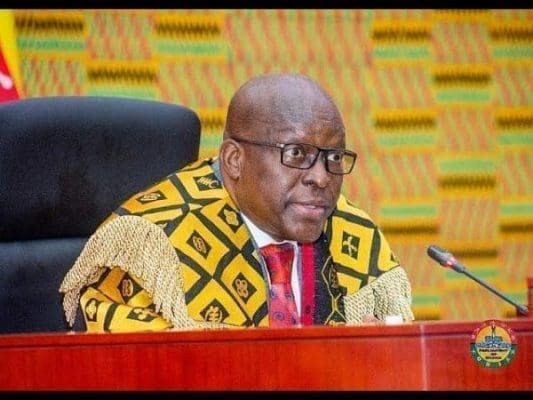
Speaker of Parliament Alban Sumana Kingsford Bagbin has announced plans to introduce an electronic voting system in the House while renewing calls for a permanent Parliamentary complex. The Speaker made the announcements on Thursday, February 12, 2026, at the launch of Parliament’s Corporate Strategic Plan for 2026 to 2030 in Accra.
Bagbin described the electronic voting initiative as a practical step toward improving decision-making processes amid infrastructural limitations. He acknowledged difficulties Members of Parliament face, particularly during contentious decisions requiring manual vote counting.
Parliament is beginning a pilot phase of electronic voting to address challenges associated with reliance on manual processes. The Speaker stated this has sometimes slowed proceedings and placed pressure on parliamentary staff.
Bagbin explained that electronic voting would ease struggles during House decision-making. He noted the system would streamline parliamentary proceedings and improve transparency when consensus cannot be reached on legislative matters.
The Speaker also urged the Executive to allocate land near the State House for construction of a permanent Parliamentary complex. He described Parliament’s current status as tenants within the State House enclave as restrictive and inappropriate for an independent arm of government.
Bagbin said a formal request has already been forwarded to the Executive for a parcel of land close to the current location. He stressed that as an independent arm of government, Parliament requires a purpose-built complex to function effectively and symbolize institutional autonomy.
According to the Speaker, infrastructural challenges continue to affect parliamentary operations. He noted that certain facilities within the enclave are not freely accessible to Parliament without payment, including the banquet hall which has fallen into disuse.
The Corporate Strategic Plan for 2026 to 2030 outlines a roadmap for improving Parliament’s efficiency, oversight and public service delivery. It envisions an inclusive and proactive Legislature grounded in constitutional principles and supported by evidence-based decision-making.
Bagbin highlighted five focus areas of the plan including legislative management, parliamentary oversight and accountability, parliamentary representation, parliamentary diplomacy, and parliamentary support services. He said the plan was developed through extensive consultation with civil society, development partners and other stakeholders.
The Speaker noted the plan built on achievements of previous plans while responding to prevailing challenges and global trends. He explained it integrated key strategic and stakeholder priorities for the medium-term period from 2026 to 2030.
Notable achievements of preceding strategic plans included successful adoption of a new organizational structure which strengthened leadership capacity and improved functional alignment. That reform was complemented by improvements in Members of Parliament facilities and welfare, staff conditions of service and working environment.
Bagbin reminded Members of Parliament that the House now operates within an increasingly demanding, dynamic and uncertain global environment. He stressed that complexity of national governance is deepening and public expectations continue to rise, with rapid technological change reshaping how institutions function.
Having built and strengthened the drafting department in Parliament, the Speaker said the House no longer depends on the Office of the Attorney-General for most of its legal work. This represents enhanced institutional capacity for independent legislative drafting and review.
In October 2025, Bagbin raised concerns about limited capacity of the current parliamentary chamber. He cautioned that structural integrity of the facility could be compromised if the number of Members of Parliament continues to increase.
In 2019, the New Patriotic Party (NPP) government proposed construction of a new Parliamentary chamber. The proposal faced strong opposition from the Minority in Parliament and civil society organizations, culminating in the widely publicized DropTheChamber protest.
The push for improved parliamentary infrastructure comes amid broader national discussions about strengthening democratic institutions and enhancing governance systems in Ghana. Bagbin reiterated Parliament’s commitment to strengthening democracy, transparency and accountability.
The Speaker encouraged citizens to hold public officials accountable, stating that good governance is not just a giving but the vigilance of all that keeps politicians behaving well. He emphasized Parliament’s role as a central pillar of Ghana’s democracy requiring adequate facilities to discharge its constitutional mandates.
Source: www.newsghana.com.gh


TV3’s Godwin Asediba wins the 2025 BBC Komla Dumor Award
Media General Journalist and News Anchor Godwin Asediba has been adjudged winner of the 2025 BBC News Komla Dumor Award....


Government imposes GHC10,000 daily fine on DSTV for failure to submit pricing data
The Ministry of Communication, Digital Technology, and Innovations has impose a statutory fine of GHC10,000 per day on MultiChoice Ghana...


President Mahama to walk the runway at Ghana Fashion Week in July
In a bold and exciting announcement, President John Dramani Mahama revealed that he will make a special appearance on the...


Chez Amis gifts herself Rolls Royce Cullinan on birthday
Renowned Accra-based restaurateur Chez Amis has marked her birthday in grand style by gifting herself a brand-new Rolls Royce Cullinan,...


Akosua Ago Aboagye joins Sompa FM as Accra branch radio manager
Seasoned broadcaster Akosua Ago Aboagye has joined Sompa FM as the Radio Manager for its Accra branch. She made the...


Mahama unveils ‘Black Star Experience’ to boost tourism and culture
President John Dramani Mahama has announced the launch of ‘The Black Star Experience’ as part of his administration’s vision to...
-

 Showbiz4 days ago
Wanlov reveals how he used cutlasses to evade school authorities
-

 Politics5 days ago
Afenyo-Markin Takes NPP’s Political Philosophy to UCC Students
-

 Showbiz4 days ago
He treats us like children
-

 Showbiz6 days ago
I questioned God in my desperation for a child – Diana Hamilton opens up about faith
-

 Showbiz4 days ago
Man pleads with policewomen to be kind after kids traumatized by past incident
-
Politics4 days ago
Afenyo-Markin Tells UCC Students Mahama’s Flagship Plans Remain Unfulfilled
-

 Politics2 weeks ago
Omane Acheampong Criticizes Government’s Cocoa Sector Price Reduction
-

 Politics7 days ago
Kpebu: SALL Disenfranchisement Alone Should Have Sealed EC Removal Case